


500m OTDR Launch Cable Box – Dead Zone Eliminator for Accurate Near-End Fiber Testing | G652D | SC / FC / LC / ST | UPC & APC
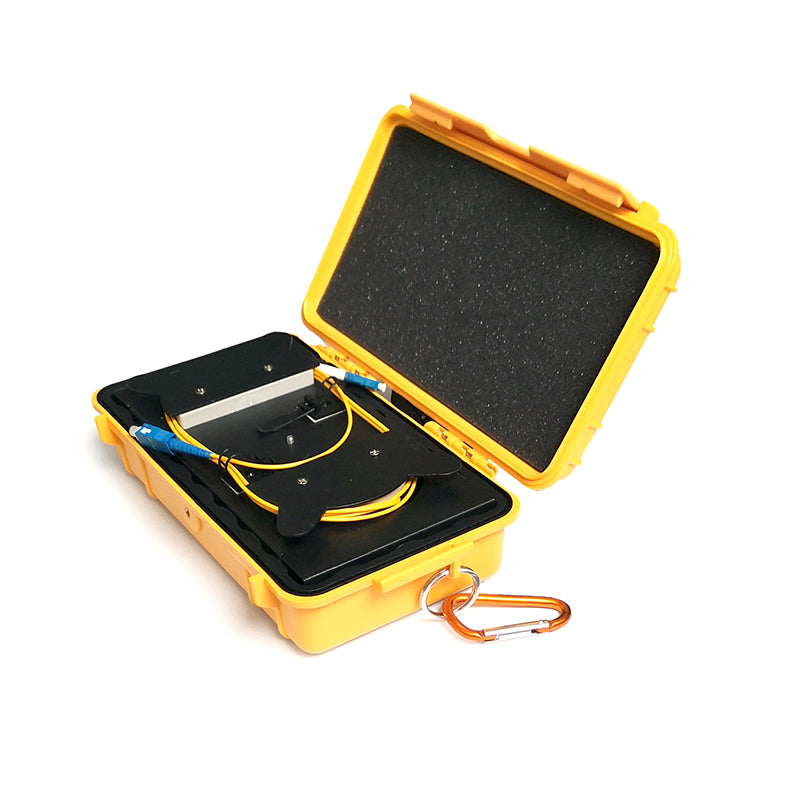
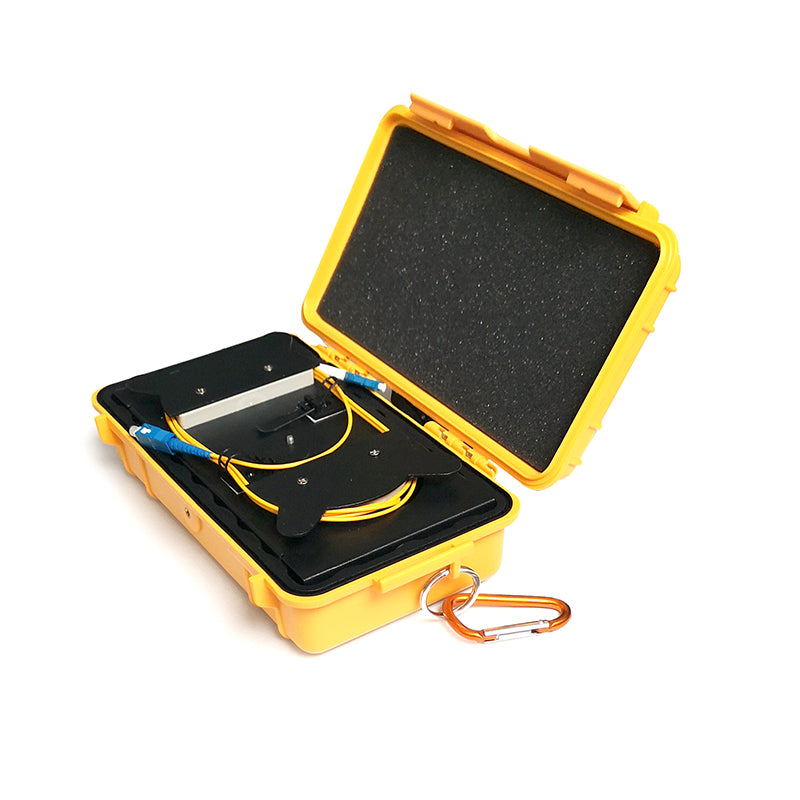
The 500m OTDR Launch Cable Box is a compact, field-ready fiber optic launch cable assembly containing 500 meters of G652D singlemode fiber wound inside a ruggedized, IP54-rated hard-shell case. It connects between the OTDR and the fiber link under test to eliminate the OTDR’s near-end dead zone, enabling accurate measurement of insertion loss and reflectance at the first connector of the link — measurements that would otherwise be masked by the OTDR’s launch pulse recovery time.
Available with SC, FC, LC, and ST connectors in both UPC and APC polish, the 500m launch cable box is the most compact and lightweight option in the OTDR launch cable range — ideal for FTTH drop fiber testing, short-range singlemode fiber characterization, and field technicians who need a portable dead zone eliminator for OTDRs operating at short pulse widths.
What Is an OTDR Launch Cable Box and When Is 500m Sufficient?
Every OTDR has a dead zone at the beginning of a trace — a blind region caused by the recovery time of the OTDR’s receiver after the high-power launch pulse. During this dead zone, the OTDR cannot accurately measure events (connectors, splices, faults) on the fiber. The dead zone has two components:
- Event Dead Zone (EDZ): The minimum distance after a reflective event before the OTDR can detect another event — typically 1–5 meters for modern OTDRs
- Attenuation Dead Zone (ADZ): The minimum distance after a reflective event before the OTDR can accurately measure loss — typically 10–80 meters for modern OTDRs at short pulse widths
A 500m launch cable is sufficient for OTDRs operating at short pulse widths (<100ns), where the attenuation dead zone is typically less than 50–100 meters. This covers most modern handheld OTDRs used for FTTH drop fiber testing and short-range singlemode fiber characterization. For OTDRs using medium pulse widths (100ns–500ns) for longer fiber links, a 1000m launch cable is recommended. For long-haul testing with long pulse widths (>1µs), a 2000m launch cable is required.
Key Features
- 500m G652D Singlemode Fiber: ITU-T G652.D compliant singlemode fiber — the standard fiber type for FTTH, telecom OSP, and long-haul applications. Low attenuation ensures the launch cable itself does not significantly reduce OTDR dynamic range
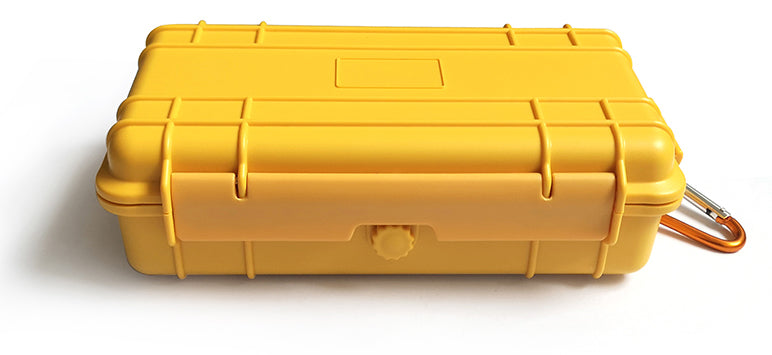
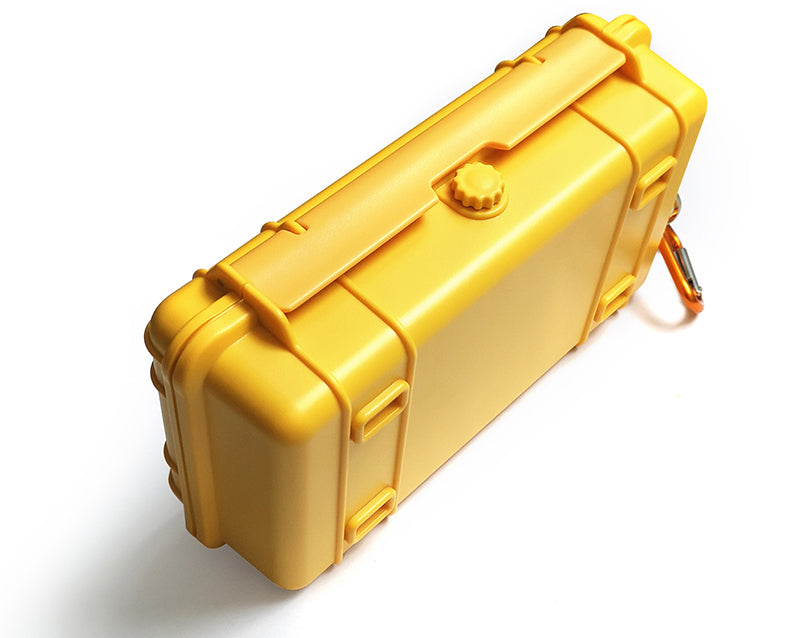
- IP54 Ruggedized Hard-Shell Case: SR Polypropylene case with compound latch and locking feature — IP54 rated for water and dust resistance. Suitable for indoor and outdoor use across a wide temperature range (-40°C to +85°C)
- Compact and Lightweight: The 500m configuration is the most portable option in the launch cable range — lighter than 1000m and 2000m versions, ideal for field technicians working from a tool bag or belt
- Robust Carabiner Clip: Allows the launch box to be clipped to a belt, ladder, or equipment rack during testing — keeping both hands free in the field
- Built-In Cable Management: Fiber is neatly wound inside the case with built-in cable management — no tangling or kinking during deployment and retrieval
- Auto-Purge Valve: Prevents pressure buildup inside the sealed case during temperature changes — maintains case integrity in outdoor environments
- SC / FC / LC / ST Connectors, UPC & APC: Available in the most common singlemode connector types and polish types — select the configuration that matches your OTDR port and the fiber link under test
- 2-Meter Lead Cables: 3mm buffer lead cables on both ends provide strain relief and easy connection to the OTDR port and the fiber link under test
Fiber & Connector Specifications
| Parameter | Specification |
|---|---|
| Fiber Type | G652D (ITU-T G652.D singlemode) |
| Fiber Length | 500m |
| Lead Length | 2 meters, 3mm buffer |
| Typical Loss | <0.5dB @ 1310nm (500m total) |
| Connector Types | SC, FC, LC, ST |
| Polish Types | UPC, APC, PC |
| Return Loss (UPC) | ≥50dB |
| Return Loss (APC) | ≥60dB |
| Return Loss (PC) | ≥35dB |
| Repeatability | ≤0.2dB (1,000 mating cycles) |
| Exchangeability | ≤0.2dB |
Mechanical & Environmental Specifications
| Parameter | Specification |
|---|---|
| Case Dimensions | 238mm × 141mm × 67mm |
| Case Material | SR Polypropylene |
| Case Color | Yellow |
| IP Rating | IP54 |
| Weight (without fiber) | 0.75kg |
| Operating Temperature | -40°C to +85°C |
| Storage Temperature | -40°C to +85°C |
| Humidity | 0 to 95%, non-condensing |
Compliance Standards
- ITU-T G652.D (singlemode fiber)
- ITU-T G656.A
- ITU-T G651.1 OM1, OM2, OM3, OM4
- IEC 60793-2-10 Type A1a.1/A1b (OM1/OM2), Type A1a.2 (OM3), Type A1a.3 (OM4)
- Telcordia GR-326-Core
- RoHS Compliant — Directive 2011/65/EU
How to Use the OTDR Launch Cable Box
- Select the correct connector configuration — match the launch cable’s connector type (SC/FC/LC/ST) and polish (UPC/APC) to your OTDR’s optical port and the fiber link under test
- Clean the connectors — inspect and clean both the OTDR port and the launch cable connectors before connecting. Contaminated connectors are the most common cause of poor OTDR traces
- Connect the launch cable to the OTDR — plug one end of the launch cable into the OTDR’s optical port
- Connect the launch cable to the fiber under test — plug the other end into the first connector of the fiber link under test
- Set the OTDR range and pulse width — set the OTDR range to cover the full length of the fiber link plus the 500m launch cable. The OTDR trace will show the launch cable as the first 500m before the link under test begins
- Acquire the OTDR trace — the near-end connector of the link under test will now appear clearly in the OTDR trace, outside the dead zone, with accurate loss and reflectance measurements
500m vs. 1000m vs. 2000m Launch Cable: Which Length Do You Need?
| Launch Cable Length | Recommended Use Case | Dead Zone Coverage |
|---|---|---|
| 500m (this listing) | FTTH drop fiber testing, short-range singlemode testing, OTDRs with short pulse widths (<100ns) | Covers EDZ and ADZ for most modern OTDRs at short pulse widths |
| 1000m | Standard FTTH feeder and distribution fiber testing, telecom OSP acceptance testing, medium pulse widths (100ns–500ns) | Covers ADZ for most OTDRs at medium pulse widths |
| 2000m | Long-haul testing, OTDRs with long pulse widths (>1µs), maximum dead zone coverage | Covers ADZ for all OTDRs including those with long pulse widths |
We also stock 1000m and 2000m OTDR launch cable boxes in the same connector configurations — see our related listings.
Ideal Applications
- FTTH drop fiber testing — OTDR characterization of short FTTH drop cables from the splitter to the ONT; the 500m length is ideal for modern handheld OTDRs used in FTTH drop testing workflows
- Short-range singlemode fiber characterization — measuring insertion loss, reflectance, and splice loss on short singlemode fiber links for network commissioning and maintenance
- Field technician portable kit — the 500m configuration is the most compact and lightweight option, ideal for field technicians who carry their OTDR in a tool bag and need a portable dead zone eliminator
- Fiber fault location — locating breaks, high-loss splices, and connector faults near the launch end of a fiber link that would otherwise be hidden in the OTDR dead zone
- Bidirectional OTDR testing — used as both a launch cable (near end) and a receive cable (far end) for bidirectional OTDR measurements required by IEC 61280-4-1 and TIA-568
Frequently Asked Questions
Q: What is an OTDR launch cable box?
A: An OTDR launch cable box is a fiber optic cable assembly — typically 500m to 2000m of singlemode fiber wound in a protective case — connected between the OTDR and the fiber link under test. It pushes the OTDR’s dead zone away from the beginning of the link, allowing accurate measurement of the near-end connector and events close to the launch end of the fiber.
Q: Is 500m enough for my OTDR testing?
A: A 500m launch cable is sufficient for OTDRs operating at short pulse widths (<100ns), where the attenuation dead zone is typically less than 50–100 meters. This covers most modern handheld OTDRs used for FTTH drop fiber testing. If your OTDR uses medium pulse widths (100ns–500ns) for longer fiber links, a 1000m launch cable is recommended. For long-haul testing with long pulse widths (>1µs), use a 2000m launch cable.
Q: What connector type and polish should I choose?
A: Choose the connector type (SC, FC, LC, or ST) that matches your OTDR’s optical port and the fiber link under test. Choose APC (green connector, 8° angled) if your OTDR port or fiber link uses APC connectors — common in FTTH and PON networks. Choose UPC (blue connector) for standard telecom and enterprise fiber applications. APC and UPC connectors are not interchangeable.
Q: Does the launch cable fiber type need to match the fiber under test?
A: Yes. The fiber type (singlemode/multimode), core size, and modal field diameter (MFD) of the launch cable must match the fiber under test to ensure measurement accuracy. This launch cable uses G652D singlemode fiber and is compatible with all standard singlemode OTDRs and singlemode fiber links.
Q: Can I use this launch cable box as a receive cable?
A: Yes. The launch cable box can be used as both a launch cable (connected at the near end of the OTDR) and a receive cable (connected at the far end of the fiber link) for bidirectional OTDR testing required by IEC 61280-4-1 and TIA-568.
Q: Is the case waterproof?
A: The case is IP54 rated for water and dust resistance, suitable for indoor and outdoor use across a wide temperature range (-40°C to +85°C). It features an auto-purge valve to prevent pressure buildup during temperature changes.
Q: What fiber lengths are available?
A: We stock 500m (this listing), 1000m, and 2000m OTDR launch cable boxes in the same connector configurations (SC/FC/LC/ST, UPC/APC). Custom lengths from 100m to 2200m are also available — contact us for custom orders.
Q: For support or bulk orders?
A: Contact us at sales@opticfibertool.com for B2B pricing, volume orders, or technical support.
Package Contents
- 500m OTDR Launch Cable Box (G652D fiber, selected connector type and polish) ×1